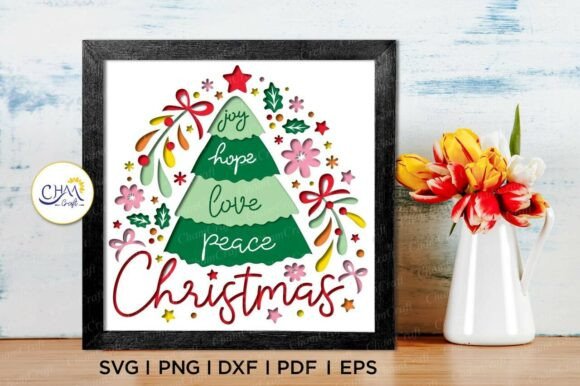
Review: 3D Christmas Tree Shadow Box SVG for Holiday Projects
As a designer who spends most of the year digitizing and testing files for small business owners, I approach every new machine embroidery design with a critical eye. It is not enough for a file to look good on a screen; it must translate beautifully into thread, withstand washing, and elevate the perceived value of the finished product. Recently, I evaluated the 3D Christmas Tree Shadow Box SVG to see how it holds up for real-world holiday projects. While this file is marketed primarily as a layered paper cut template for light boxes, its structural integrity and clean lines offer intriguing possibilities for textile applications if handled with the right expertise.
First Impressions and Visual Personality
Upon opening the file, the first thing that strikes me is the mood. The design captures a cozy, nostalgic holiday embroidery vibe without feeling cluttered. The layout relies on distinct layers to create depth, which is the hallmark of a shadow box style. For an embroiderer, this translates to a design that demands precision in layering or clever use of stitch types to mimic that dimensional look. The shape is classic, fitting perfectly within the stated 8×8 inch dimensions, making it a substantial statement piece rather than a subtle accent.
The visual personality is clean and modern yet rooted in tradition. It avoids overly intricate details that often turn into a mess of thread breaks, suggesting that the original vector paths are well-optimized. However, because this is fundamentally a 3D SVG intended for paper crafting, adapting it for fabric requires a shift in thinking. You aren't cutting cardstock; you are navigating fabric texture, stretch, and stitch density. The design's strength lies in its bold silhouettes, which can be effectively rendered using a combination of satin stitch for outlines and fill stitch for the tree sections to create a rich, tactile surface.
Real-World Application Scenarios
To truly test the viability of this embroidery file, I imagined a specific client scenario: a boutique owner preparing a limited run of premium holiday tote bags and sweatshirts. The goal was to create a handmade product that feels exclusive and high-end. For a heavy canvas tote bag design, the 8×8 inch scale is perfect. It covers a significant portion of the bag's face, acting as the primary branding element. In this context, the layered nature of the 3D Christmas Tree Shadow Box SVG could be interpreted by stitching different shades of green in overlapping sections, creating a faux-3D effect that mimics the paper-cut aesthetic.
For sweatshirt embroidery, the application becomes trickier but equally rewarding. A fleece or French terry background provides a lovely contrast to the dense stitching required for the tree. Here, the design serves as a focal point for a personalized gift or a small shop's seasonal merchandise. Imagine monogramming the base layer or adding a name beneath the tree in a complementary script. This transforms a standard digital asset into a custom apparel item that customers are willing to pay a premium for. The clean lines ensure that even from a distance, the image reads clearly, which is crucial for Etsy seller listings where thumbnail clarity drives clicks.
Beyond apparel, this design shines in home decor. A pillow cover or a kitchen towel featuring this motif instantly updates a room for the season. Because the design is symmetrical and balanced, it works well centered on a square pillow. For a baby embroidery project, such as a nursery wall hanging or a blanket border, the soft, rounded elements of the tree design feel gentle and appropriate, provided the stitch density is reduced to keep the fabric pliable.
Technical Considerations and Fabric Challenges
While the potential is high, there are areas where caution is necessary. Since the 3D Christmas Tree Shadow Box SVG was originally conceived for rigid paper, transferring it to flexible textiles introduces variables. One major consideration is stitch density. If you simply convert the vector layers directly to fill stitches without adjustment, the result could be stiff and board-like, especially on an 8-inch design. This is acceptable for a patch or a structured bag but undesirable for a garment that needs to drape.
Working on textured fabrics like towels or waffle weave requires careful attention. The "shadow" effect relies on crisp edges between layers. On a looped towel, those edges might get lost unless you use a sufficient amount of stabilizer to flatten the working area. I strongly recommend testing the design on scrap fabric first. Check how the thread colors interact with the base material. A dark green thread on a black sweatshirt might vanish, ruining the layered illusion. Always compare light and dark fabric backgrounds before committing to a production run.
Curved surfaces present another challenge. Attempting to stitch this large, detailed design on a cap is risky. The curvature of the front panel can distort the straight lines essential to the shadow box look, causing registration issues between the "layers." Furthermore, small hoop sizes may require splitting the design, which can leave visible seams that detract from the professional look. For items like aprons or flat patches, the design performs much more reliably.
Enhancing Brand Value and Customer Trust
In the world of commercial embroidery, consistency is key to building brand trust. Using a well-structured file like the 3D Christmas Tree Shadow Box SVG allows for uniformity across different products. Whether you are making an embroidered patch for a lapel or a large motif for a blanket, the core geometry remains recognizable. This recognition fosters buyer engagement. When a customer sees a cohesive collection of holiday items, they perceive the maker as a professional rather than a hobbyist.
The visual appeal of this design directly impacts the perceived value of your small shop product. Clean stitching and thoughtful color choices signal quality. Conversely, poor execution—such as puckering fabric or misaligned layers—can damage your reputation. Therefore, inspecting small details before finalizing the embroidery project is non-negotiable. Look at the corners of the star or the base of the tree; these are areas where threads often bunch up if the digitizing isn't optimized for fabric.
Practical Notes for Designers and Makers
Before integrating this digital embroidery file into your workflow, here are a few practical steps to ensure success. First, verify the licensing terms. Just because a file is available for purchase does not automatically grant rights for unlimited commercial use or resale as a digital asset. Confirm whether you can sell finished items or if there are restrictions on the number of units. Second, consider creating printable mockups. Visualizing the design on a virtual t-shirt or mug can help you decide on thread palettes without wasting materials.
Always review the stitch count and density settings in your embroidery software. You may need to manually adjust underlay stitches or reduce fill density to accommodate stretchy fabrics. Test the design in black and white mockups to ensure the contrast between layers is strong enough to be seen without color reliance. Finally, remember that while the file measures 8×8 inches, resizing it significantly smaller could compromise the integrity of the fine details, while enlarging it might exceed your machine's hoop capacity.
In conclusion, the 3D Christmas Tree Shadow Box SVG is a versatile asset that bridges the gap between paper crafting and textile art. With thoughtful adaptation and rigorous testing, it can become a cornerstone of your holiday collection, delivering professional results that delight customers and enhance your brand's holiday spirit.